Adoa News Adoa News
A multi-year investigation has uncovered that the Auditor-General’s late-2022 special audit into Ghana’s COVID-19 expenditure severely understated national fumigation costs, omitting at least GHS 684 million spent across multiple ministries.
While the Auditor-General’s report commissioned by former Finance Minister Ken Ofori-Atta captured just GHS 96.3 million for fumigation, verified documents, contract records, and Right to Information responses reveal actual spending across three key ministries reached at least GHS 780 million. The official audit figure represents only 12% of the total outlay uncovered.
Breakdown of Omitted Expenditures
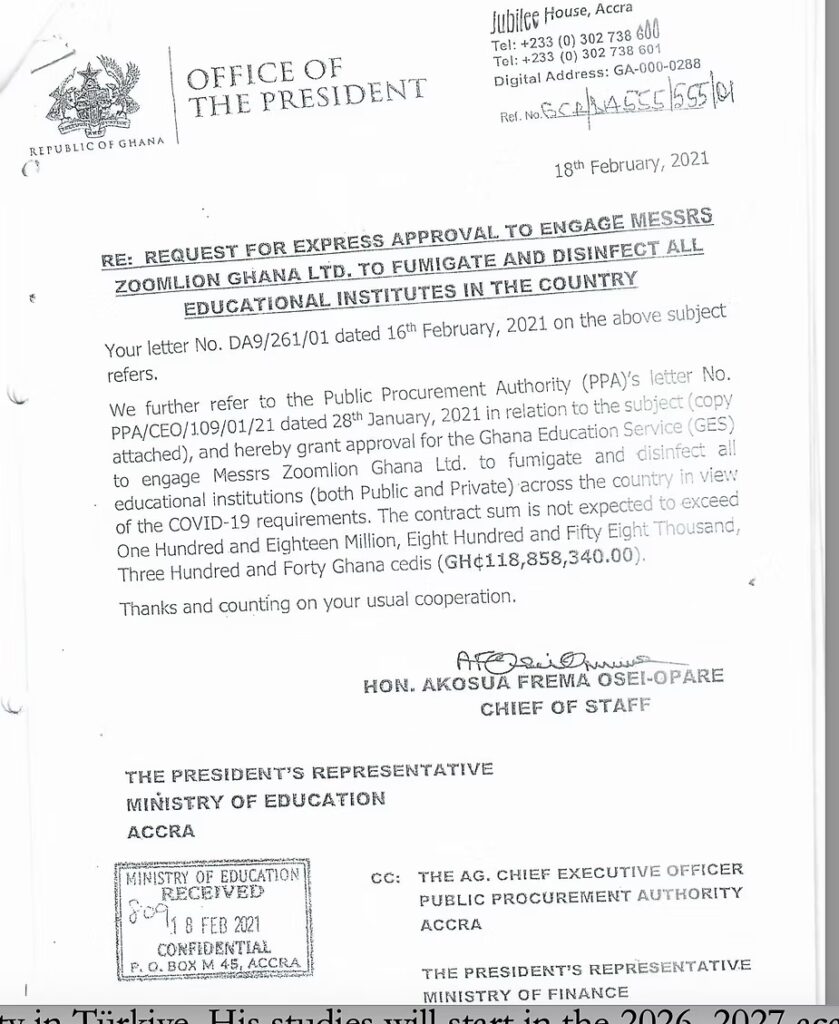
The Ministry of Education spent GHS 316.1 million across three fumigation phases between June 2020 and March 2021, yet the Auditor-General recorded only the second phase of GHS 96.3 million. The Ministry of Local Government, Decentralisation and Rural Development expended GHS 299 million across three market fumigation phases, none of which appeared under the audit’s official total. Additionally, the Ministry of Transport paid GHS 159.9 million between 2020 and 2022, which was also entirely left out of the report’s fumigation breakdown.
Approximately GHS 775 million or 99.4% of the uncovered GHS 780 million expenditure was awarded to a single firm, Zoomlion Ghana Limited, primarily through single-source procurement methods.


Audit Service Response and Legal Concerns
Responding to the discrepancies, the Ghana Audit Service acknowledged auditing the Local Government Ministry and early phases of the Education Ministry’s spending, but offered no explanation for omitting those figures from the published total, dismissing allegations of a deliberate cover-up.
Former Auditor-General Daniel Domelevo criticized the audit’s scope and origin, noting that a spending minister initiating an audit of their own ministry raises clear legal and conflict-of-interest concerns.
Scientific Opposition and Public Accounting Impact
Furthermore, leading scientists at the Noguchi Memorial Institute for Medical Research and the Kumasi Centre for Collaborative Research emphasized that mass surface fumigation offered no scientific benefit against COVID-19, particularly in locked or unoccupied facilities. World Health Organization guidance issued in May 2020 similarly warned against indoor and outdoor mass spraying.
The findings highlight significant gaps in public accounting, revealing that hundreds of millions in state funds were deployed on unproven interventions while remaining unrecorded in official oversight reports.