Adoa News Adoa News
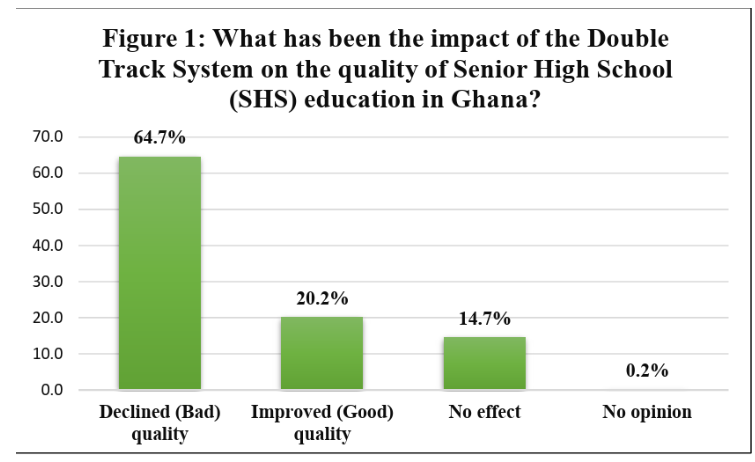
A new nationwide poll by the Institute of Economic Affairs (IEA) has found that 64.7% of respondents believe Ghana’s Double-Track System has negatively affected the quality of Senior High School (SHS) education.
The survey, conducted in August 2026, covered 1,062 respondents across all 16 regions of the country. The IEA said the findings reflect public concerns about the impact of the system, which was introduced in 2018 to accommodate increased SHS enrolment amid infrastructure constraints.
Only 20.2% of respondents said the Double-Track System had improved the quality of secondary education, while 14.7% said it had no effect and 0.2% expressed no opinion.
The poll also examined public views on the government’s proposal to borrow to construct additional SHS infrastructure and eventually phase out the Double-Track System.
54.3% Support Borrowing for More SHS Infrastructure
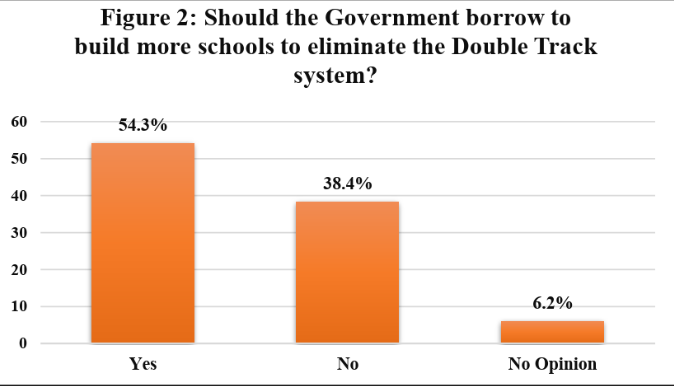
The findings show that 54.3% of respondents support government borrowing to build additional schools, while 38.4% oppose the proposal and 6.2% expressed no opinion.
Among respondents who believe the Double-Track System has reduced education quality, 60.8% support borrowing to expand SHS infrastructure and end the system.
The IEA noted, however, that support for infrastructure expansion exists alongside concerns about the fiscal implications of additional borrowing, particularly given Ghana’s public debt position.
The Double-Track System was introduced as a temporary measure to enable more students to access secondary education using existing school facilities. The IEA said the latest findings point to a public concern about the relationship between increased access and education quality, while also highlighting the need for sustainable financing of any infrastructure expansion.